“Solar AI GPU mining” combines several ideas that deserve separate definitions. A graphics processor can run AI workloads, and some graphics processors can participate in particular cryptocurrency workloads. Neither activity becomes Bitcoin mining simply because it uses electricity from solar panels. Before sizing an array or choosing a computer, identify the exact work the machine will perform and how useful output will be measured.
This distinction matters because an energy plan follows the workload. A research job that can pause has different needs from a service that promises immediate responses. A machine that performs a narrow hashing task has different selection criteria from a computer that must hold a model in memory. The solar AI GPU overview provides the terminology; this guide turns it into a practical evaluation process.
Define the work before naming the hardware
Write a one-sentence workload description without using the word “mining.” For an AI project, that might be processing a fixed collection of images, running a local model for a research team, or completing a scheduled training experiment. For a cryptocurrency project, name the network and supported algorithm. If the description remains vague, hardware comparison is premature.
Next, define completion. An image-processing job might be complete when every input has a validated result. An interactive service might be evaluated by response time and successful requests. A mining task uses its own accepted-work and payout records. These units are not interchangeable, and a high utilization percentage does not prove that useful or paid work occurred.
Keep a representative test case
Prepare a small workload that resembles the intended use. Record the input, software environment, success criteria, and expected output format. This lets you compare operating configurations without accidentally changing the task. A repeatable test case is more valuable than a benchmark score from a workload your project will never run.
Do not treat GPUs and Bitcoin ASICs as substitutes
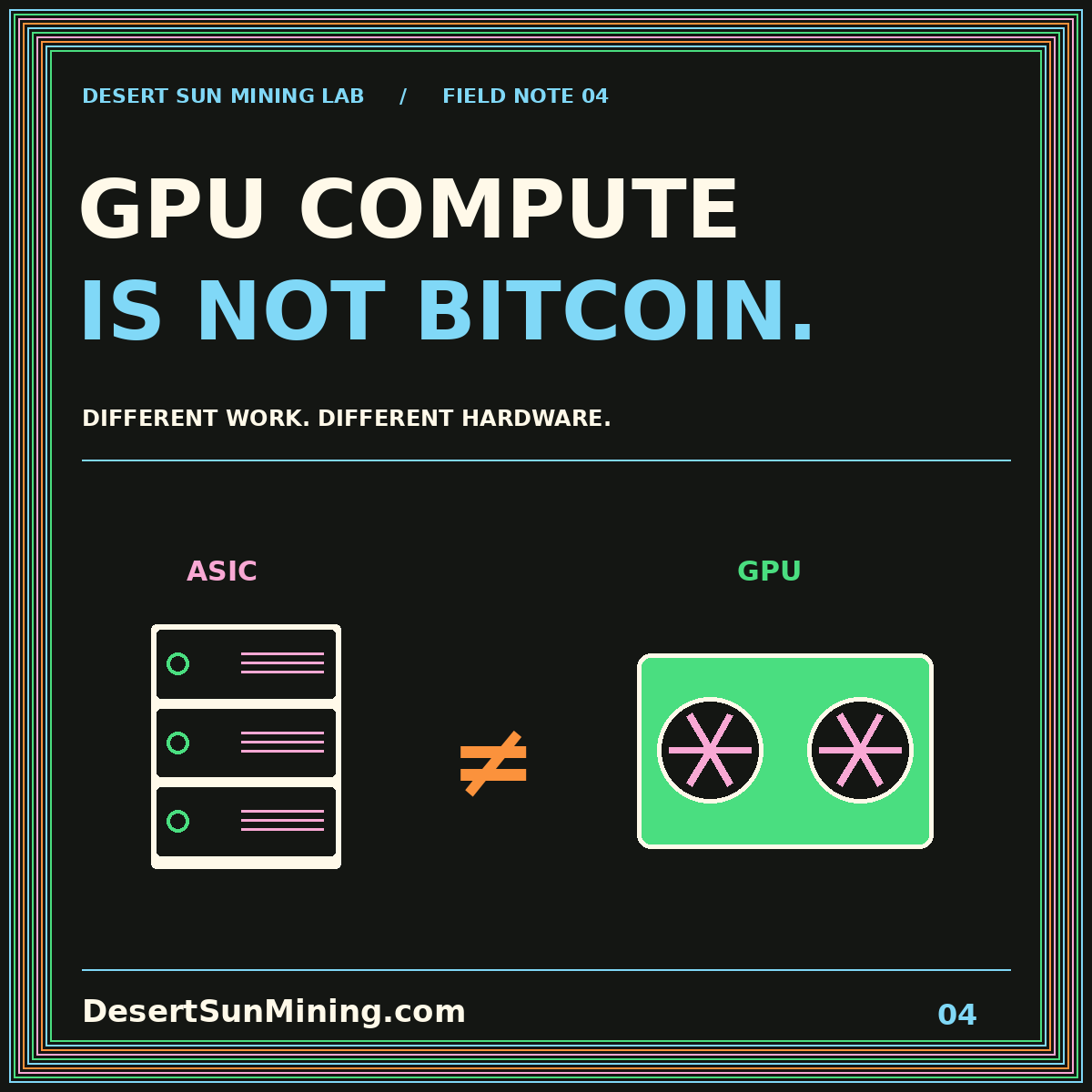
A Bitcoin ASIC is specialized for its supported hashing task. A GPU is a programmable parallel processor used across a broader range of applications. For a purchasing brief, distinguish those roles rather than presenting one as a universal upgrade for the other. Equipment suitable for an AI model is not selected by the same criteria as a Bitcoin mining appliance.
Avoid assuming that an idle AI machine can always be switched into a profitable mining mode. Compatibility, operating terms, software security, wear, electricity use, and actual demand all remain separate questions. Treat alternative workloads as proposals to evaluate, not as guaranteed ways to recover unused capacity or equipment cost.
The Bitcoin planning guide covers the proof-of-work installation separately. Keeping these plans apart prevents a mining earnings figure from being used to justify an AI service that has not yet identified customers, workload requirements, or an acceptable availability target.
Measure wall power and useful work together
Software telemetry can help explain what a GPU is doing, but it does not replace a measurement of the entire computer and its supporting equipment. The NVIDIA System Management Interface documentation describes supported power, temperature, and utilization information, along with model-dependent controls. Check which fields are available on the actual hardware rather than assuming every example applies.
Record total energy for the representative task, elapsed time, and whether its output passed validation. If you change a supported power setting, repeat the same task and compare the results. A lower instantaneous draw can be unhelpful if the task takes disproportionately longer; a shorter run can also be unhelpful if output quality changes or the process becomes unstable.
For an invented example, one configuration completes a batch using 1.8 kilowatt-hours and another uses 1.5. If both produce acceptable output under equivalent conditions, the second used less measured energy for that batch. That conclusion is narrower and more defensible than claiming that the second configuration is universally better for all AI work.
Match the workload to the solar window
Identify which jobs can wait, which can pause, and which must remain available. A batch of independent tasks may be scheduled for a chosen operating window. A long-running process may need tested checkpoint and recovery behavior before it can tolerate interruptions. A customer-facing service needs an availability plan that does not depend on a clear sky.
Do not assume checkpointing works merely because a software framework supports it in principle. Test saving state, stopping the job normally, restoring the environment, and validating the resumed output. Record the storage required and the time needed for recovery. A failed recovery can consume another full run’s worth of energy and invalidate an otherwise attractive schedule.
Separate normal scheduling from emergency shutdown. A planned pause can preserve useful work; a protective stop must prioritize equipment and electrical safety. The energy controller should not bypass the machine’s protections or conceal faults just to complete a job. Define the response to insufficient power before leaving the system unattended.
Build the computer around the actual model or task
Write down memory needs, storage requirements, software compatibility, and data-transfer expectations. A processor with an attractive headline specification may still be unsuitable if the intended workload cannot fit its memory or run with the required software. Use the representative task to confirm compatibility before scaling the installation.
Include the host computer and network in the power budget. Storage, system memory, CPU activity, networking, and cooling can matter even when a dashboard emphasizes the graphics processor. Identify what remains powered between jobs. A scheduled GPU that sleeps at night may still leave a substantial supporting system running unless that behavior is intentionally managed.
Keep maintenance and replacement practical. Document which parts are serviceable, where configuration records are stored, and how a failed component changes the schedule. A system that requires an unavailable specialist for every interruption may be a poor fit for a remote pilot even when its peak benchmark looks impressive.
Treat hosted work as a separate business question
If the project intends to sell compute, define the service before discussing income. What can a customer submit? How is access controlled? What happens to stored data? What response or completion time is promised? These questions remain unanswered by the presence of a GPU, an internet connection, or a solar array.
Avoid placing untrusted customer workloads directly beside sensitive management systems without an appropriate security design. Do not advertise privacy or isolation guarantees that have not been implemented and tested. A small local workload with known inputs can be a more manageable pilot than an open service that accepts arbitrary code from strangers.
Keep revenue assumptions separate from energy measurements. Completed local tasks establish technical capability, not market demand. A listing on a compute marketplace does not guarantee paid occupancy. Record actual receipts only when they occur, and account for fees, maintenance, idle time, and the work required to operate the service.
Compare operating plans with the same boundaries
For each candidate plan, use the same workload, site assumptions, and accounting period. Record which components are included in the energy measurement and which are excluded. If one plan relies on grid support and another intentionally stops at sunset, show that difference rather than comparing their output as though availability were equal.
A useful pilot report explains what completed, how much energy it consumed, what failed, and what remains uncertain. It should also state whether the project met its intended schedule. That information supports a real next decision: adjust the workload, change the operating window, improve recovery, or stop the experiment before additional spending.
Conclusion: name the job, then design the power
Solar-supported AI computing can be evaluated without calling it Bitcoin mining or promising passive income. Define useful work, test the complete computer, and verify interruption behavior. Once those facts are documented, an energy plan can support the workload you actually have rather than a collection of unrelated claims attached to the word “mining.”