“Solar food cooker mining” is best understood here as a planning idea: one site uses sunlight for computing and for cooking. It is not a claim that a cooker mines cryptocurrency, that cooking produces a mining reward, or that the two activities must share the same equipment. Defining the phrase carefully prevents a useful site-planning discussion from becoming a misleading product description.
The practical question is how separate systems can coexist without competing for essential resources or creating unsafe interfaces. A photovoltaic array may supply electrical loads, while a direct solar cooker uses reflected sunlight as heat. An electric cooking appliance is another possibility, but it belongs in the electrical load schedule. The shared-energy topic guide introduces these distinctions.
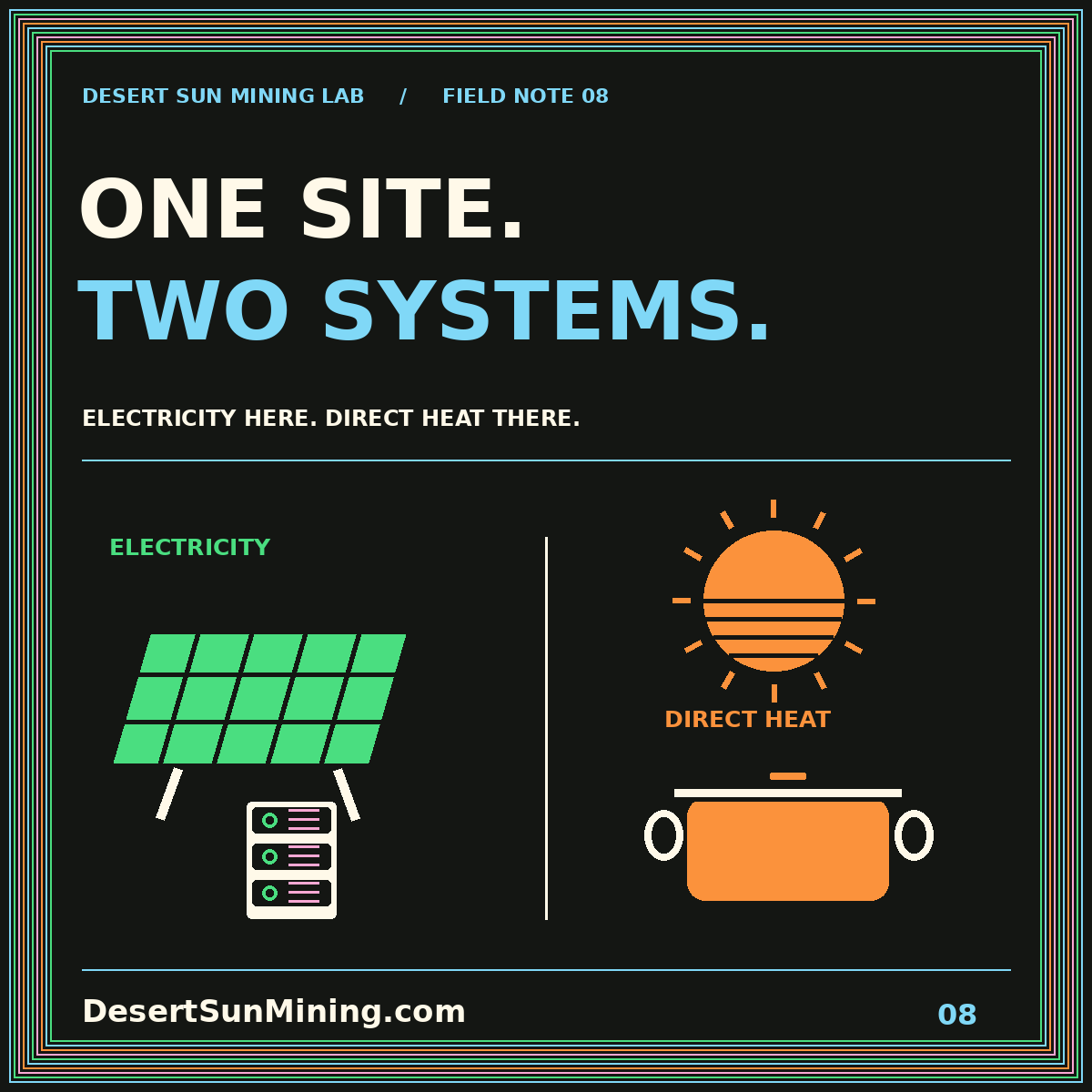
Draw two energy paths
On one side of a planning sheet, draw the electrical path from solar generation through the designed power system to the miner and supporting equipment. On the other, draw sunlight reaching a dedicated direct-heat cooker. Keep those paths separate unless the project genuinely uses an electric cooking appliance supplied by the electrical system.
For an electric cooker, draw it as a load with its own operating schedule and power requirement. Do not label it “free heat” simply because the electricity comes from the same array. For a direct solar cooker, do not subtract its thermal use from the array’s electrical production. The two systems collect sunlight separately, even when they stand on the same site.
Mark every interface
Identify shared space, access routes, operator time, and any common electrical service. These are real interfaces even when the energy paths are separate. A site plan can fail because a reflector blocks maintenance access or because the same person cannot supervise two activities at once, not only because the energy budget is wrong.
Define the priority order
List essential site services before optional experiments. Communications, refrigeration, lighting, or other locally necessary loads may need reserved capacity and a different operating policy. Decide whether mining is permitted only after those needs are satisfied. The rule should be explicit in both the operator’s instructions and the designed control system.
If cooking is electric, state how the mining load changes when the cooking appliance starts. The answer might be a scheduled pause, a supported reduction in work, or a system designed for both loads together. Do not assume two devices can share a supply simply because their average daily energy appears modest.
A priority plan is useful even when direct solar cooking uses no electrical heating. The operator’s attention, the safe working area, and the availability of backup cooking still need coordination. Energy independence in one part of a site does not remove the need for safe operation in another.
Use integration ideas without claiming a complete microgrid
The Department of Energy’s solar systems integration overview describes how solar, storage, inverters, and distributed energy resources fit into electrical systems. That provides a useful conceptual background for a shared site. It does not establish that every small collection of solar equipment can operate safely as an islanded microgrid.
Have a qualified designer define any shared electrical architecture. Grid-connected equipment, independent power systems, and portable power devices have different operating conditions and limitations. Do not improvise connections between outputs or treat a diagram of energy flows as wiring instructions. The conceptual plan should lead to a reviewed design, not replace it.
Keep the direct-heat cooker outside that electrical claim unless it genuinely contains powered components. If a cooker has a motor, controller, or fan, record that electrical demand separately from the heat delivered by sunlight. This makes the system understandable and avoids pretending that every component is passive.
Build a daily operating schedule
Write down preparation, cooking, computing, maintenance, and cleanup periods. Include the moments when people carry hot vessels or move reflectors. A schedule can reveal conflicts that a static layout misses, such as a service visit occurring while the cooking area occupies the same access route.
For a hypothetical electrical example, suppose a miner draws 2.0 kilowatts and an electric appliance draws 1.0 kilowatt during a cooking period. Their simultaneous demand is 3.0 kilowatts before supporting loads are added. Their separate daily energy totals do not eliminate that concurrent power requirement. These are assumed figures for demonstrating the scheduling issue, not equipment recommendations.
Compare that with a separate direct-heat cooker. Its heating demand is not added to the electrical load, but it still needs suitable sunlight, supervision, safe food handling, and a backup plan. The distinction lets you compare arrangements honestly instead of attributing every benefit to a vague idea of shared solar power.
Separate food handling from equipment exhaust
Plan a clean cooking and preparation area away from computing equipment, maintenance materials, and discharged air. Do not route unfiltered mining exhaust directly over food or treat warm exhaust as a validated cooking process. A proposal to recover heat would need its own engineered heat-transfer arrangement, food-safety assessment, and operating controls.
Recovered heat also needs a suitable temperature and a predictable source. A machine that stops when sunlight falls cannot automatically provide dependable heat for another process. Avoid promising roast temperatures, food-safety performance, or cooking times from the existence of warm air alone. Those claims require specific evidence from the designed system.
For a simple pilot, independent systems may make observation and safe operation easier. You can learn about computing energy and direct solar cooking without connecting their heat paths. Integration should solve a documented problem, not create a more complicated demonstration merely because the combined concept sounds novel.
Allocate shared costs and measurements transparently
Decide how common equipment costs will be recorded. If one array serves several electrical loads, do not assign its full cost to each load and then add the results. Conversely, do not describe the miner’s electricity as costless while allocating all solar equipment costs to the cooking project. State the allocation method and its limitations.
Keep separate output measures. Computing may be recorded as accepted work or completed jobs; cooking may be recorded as meals prepared using a validated process. Neither is a substitute for electrical energy measurement. A single blended “efficiency” number can conceal more than it explains when the outputs have different units and purposes.
For a pilot report, describe each system’s energy inputs, useful output, operating hours, and interruptions. Then describe genuinely shared resources, such as space or operator time. This format makes the combined site understandable without inventing a universal conversion between a prepared meal and a unit of computing work.
Commission the site in stages
First confirm each system’s intended operation independently. Review electrical documentation with the responsible professional and review cooking procedures with the people who will use the cooker. Verify access, shutdown instructions, and the location of backup equipment. Resolve any conflict before scheduling simultaneous operation.
Next, observe the two activities together under the conditions allowed by their instructions. Look for blocked walkways, competing supervision needs, noise that interferes with communication, and unexpected load overlap. Record those observations as site-planning findings. Do not bypass an equipment limit simply to demonstrate that both systems can operate at once.
Use the solar food-safety article for the cooking side and the battery guide when stored electrical energy is involved. Each discipline retains its own requirements, even when the project shares a name, a location, and a source of sunlight.
Conclusion: integration should remain understandable
A credible shared-energy site has clear energy paths, explicit priorities, safe physical separation, and honest measurements. Direct solar cooking and photovoltaic-powered mining can be discussed together without pretending they are one technology. Start with independently sound systems, then integrate only where a reviewed design provides a practical, verifiable benefit.