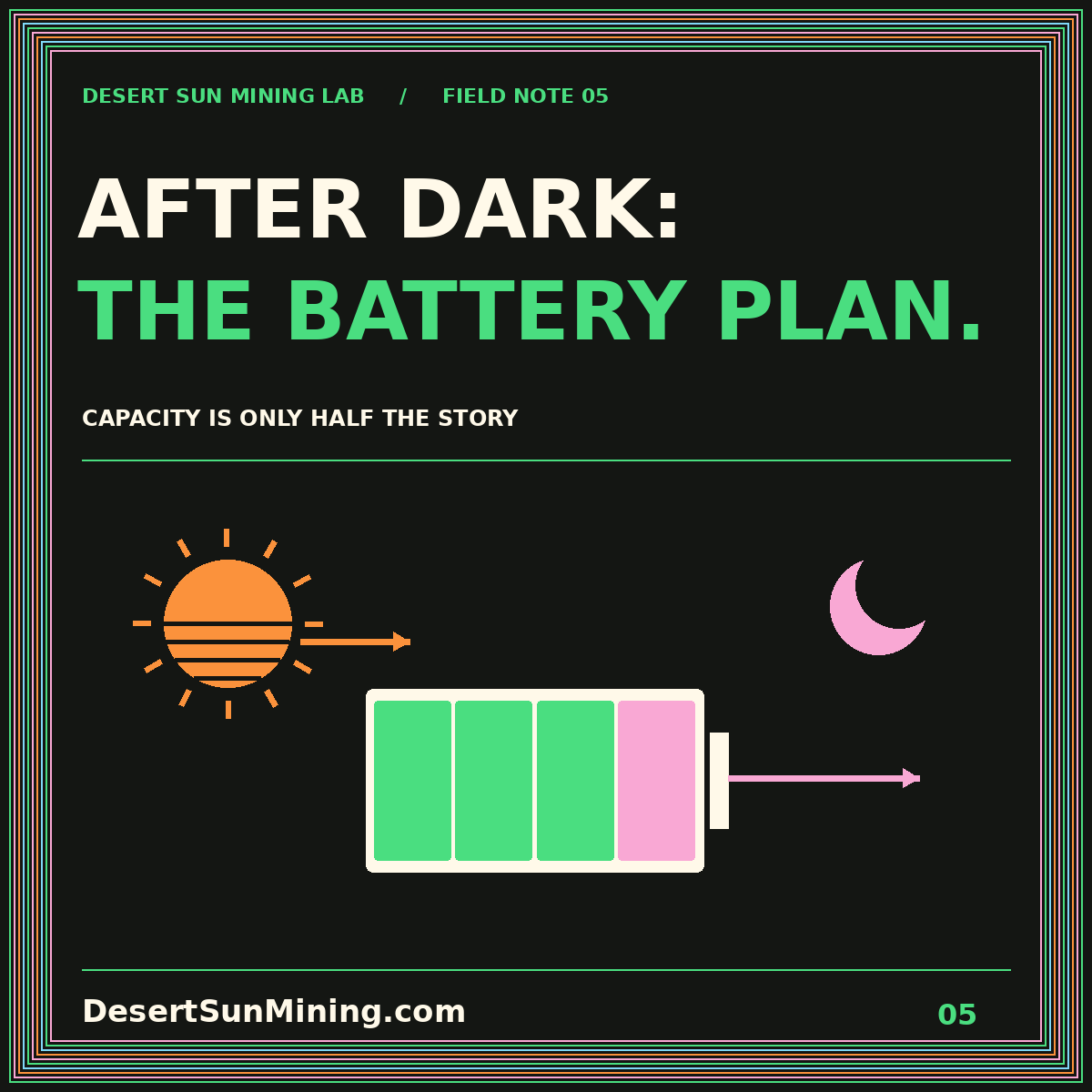
Battery sizing begins with a boundary: which loads must continue, for how long, and under what conditions? Without that boundary, a request for “enough storage for the miner” has no definite answer. A short bridge through passing cloud, a planned evening session, and several days without useful generation are different design problems with different consequences for equipment, space, and budget.
This article uses a hypothetical installation to separate those problems. It is an energy-planning exercise, not instructions for assembling a battery system. Use certified equipment appropriate to the installation and have qualified professionals design and install the electrical system. The solar mining overview is the starting point for deciding whether storage belongs in the project at all.
Decide what the battery is protecting
List the loads that must remain available when generation falls. The miner may be optional while monitoring and communications remain important. A cooking appliance or refrigeration load elsewhere on the site may have a different priority. Write down those priorities explicitly rather than letting whichever device is already running consume the remaining energy.
Then state the required duration. “Four evening hours at a defined load” can be modeled. “All night whenever needed” still requires a seasonal definition and an operating schedule. Also decide whether the load can be reduced, paused, or shed before the battery reaches its protected reserve. Those choices often matter more than the advertised capacity of a particular product.
Separate convenience from essential service
An experimental miner should not silently compete with a site’s essential loads. Design the priority order so its operation does not rely on drawing down energy reserved for those services. The reserve is a policy decision as well as an equipment setting, and the operator should understand both.
Distinguish energy capacity from power capability
A battery system has an energy capacity, commonly expressed in kilowatt-hours, and a power capability, commonly expressed in kilowatts. The Department of Energy’s solar and storage explanation distinguishes these quantities and explains that energy storage involves losses. A large energy number alone does not establish that the system can supply a particular instantaneous load.
Check the allowed continuous output, any relevant transient behavior, the inverter arrangement, and the manufacturer’s operating conditions. Ask the designer to confirm that the complete system can serve the actual load. Do not infer compatibility from matching connector shapes, nominal voltage labels, or an online capacity comparison.
A useful specification identifies both the energy needed across the chosen period and the power needed while equipment is operating. Keeping those values separate avoids an expensive mistake: buying a battery that appears to contain enough energy but cannot deliver the required rate under the proposed conditions.
Work through a transparent energy example
Assume a combined mining and cooling load of 3.0 kilowatts for four hours after useful solar production ends. The desired delivered energy is therefore 12 kilowatt-hours. Suppose, solely for illustration, that the permitted usable fraction of nameplate capacity is 0.80 and the delivery path from that usable stored energy to the load is 0.90 efficient.
The screening calculation is 12 divided by 0.80 divided by 0.90, or approximately 16.7 kilowatt-hours of nameplate capacity. These assumptions are not specifications for any battery chemistry or product. Actual usable capacity, efficiency, temperature effects, aging allowances, and reserve requirements must come from the selected system and the intended installation.
Avoid applying the same allowance twice. Some product information already describes usable capacity rather than nameplate capacity. Some efficiency figures refer to a full charge-and-discharge cycle rather than discharge alone. Ask which boundary each number uses before putting it into the calculation. Consistent definitions matter more than adding an unexplained “safety factor.”
Remember that the battery must be recharged
Storage shifts energy; it does not generate it. The following day’s solar production must serve the scheduled daytime loads and provide the energy required to restore the chosen reserve. If the array only meets the daytime load, an evening run can leave a deficit that grows across successive days.
Map charging demand alongside the normal load. A battery may have a charging-power limit, and the inverter or controller may impose additional constraints. A large midday surplus is not automatically usable if the selected system cannot accept it during the available window. The charging schedule needs to be feasible as well as the discharge schedule.
For the illustrative four-hour evening run, do not simply add twelve kilowatt-hours to an array estimate and stop there. Apply the appropriate charging and conversion assumptions at clearly stated boundaries. The solar array-sizing article explains why hourly production and daily energy totals must both be examined.
Model an interruption sequence, not one perfect day
A simple worksheet can begin with a stored-energy balance, add charging energy, subtract delivered loads and applicable losses, and end with the remaining balance. Repeat that sequence across several representative days. The balance must stay within the permitted operating range; it cannot become negative or exceed the system’s usable capacity merely because a spreadsheet permits it.
Include a day with lower production, a delayed restart, and a load that runs longer than planned. These are scenarios, not forecasts. Their purpose is to reveal when the controller must stop optional work and how the system returns to its intended reserve. A plan that only succeeds from a completely full battery deserves further examination.
State the initial condition clearly. Starting every modeled day at full charge hides the effect of the previous day. If the battery begins partly depleted, carry that condition forward until the model shows a credible recovery. This small accounting discipline can prevent a large misunderstanding about autonomy.
Design shutdown and recovery behavior
Specify the point at which optional mining stops, using the actual control and protection features provided by the system. The operator should know whether the stop is a normal energy-management event or a fault requiring attention. Do not treat every shutdown as permission to reset the battery or override a limit.
Define recovery conditions separately. The battery may need to regain a reserve before the optional load restarts. A restart delay or staged load sequence may be appropriate when supported by the equipment design. Have the responsible professional confirm the logic, then test the intended behavior during commissioning without defeating protective functions.
Keep local instructions available. A remote dashboard is useful only while communications work. The site should have a documented means of identifying equipment, contacting the responsible service provider, and carrying out permitted shutdown actions. Untrained operators should not need to open enclosures or improvise electrical procedures to understand the system’s status.
Evaluate the installation beyond the capacity label
Ask about enclosure requirements, allowed temperatures, service clearances, monitoring, warranty conditions, and end-of-life handling. A battery suitable for one location may be unsuitable for another. The selected installer should explain which requirements are met by the product itself and which depend on the surrounding installation.
Keep replacement assumptions visible in the project budget without pretending to know an exact future replacement date. Compare storage-backed operation with the simpler alternative of stopping optional work outside the solar window. The right question is not whether batteries are universally worthwhile, but whether this particular operating requirement justifies this particular system.
Conclusion: buy a defined service, not a large number
A useful battery brief states the protected load, duration, power requirement, usable-energy boundary, recharge plan, and shutdown policy. It also admits when optional mining must stop. Those details turn an attractive capacity label into an understandable operating service—and make it much easier to recognize when a daylight-only pilot is the more appropriate experiment.