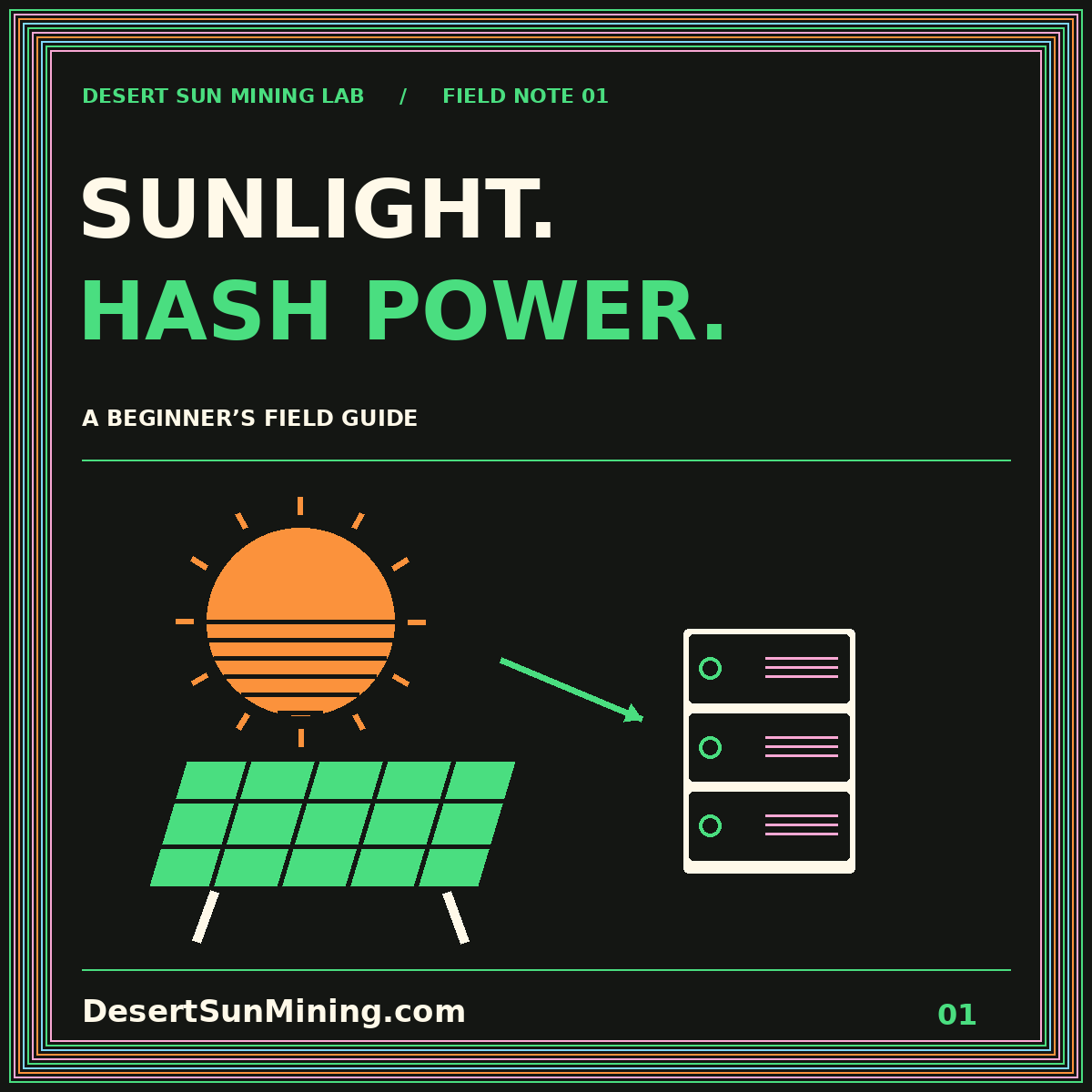
Solar Bitcoin mining starts with an ordinary question: what will power the computer when sunlight changes? The appealing image is a row of panels beside a mining machine. The useful plan is a measured electrical load, a realistic operating schedule, and a decision about what happens after sunset. Those decisions come before equipment orders, earnings estimates, or claims about energy independence.
This guide treats a small installation as a learning project first. It does not assume that a sunny location makes mining profitable, that every roof is suitable for panels, or that a solar-powered machine runs continuously. Work through the operating choices below, then use the solar Bitcoin mining overview to connect the computing side with the wider energy system.
Understand what the sun changes—and what it does not
Bitcoin mining uses computational work to participate in adding blocks to the network. Solar generation changes the source of the electricity, not the underlying proof-of-work process. A panel does not issue coins, and a sunny hour does not guarantee a successful block. The Bitcoin project’s explanation of how Bitcoin works describes the relationship between mining, transaction confirmation, and proof of work.
For planning purposes, keep three records separate: electrical energy consumed, mining work accepted, and money actually received. A device can consume electricity while its internet connection is unavailable. It can submit work without producing an immediate payout. Its reported output can also differ from the amount ultimately credited by a pool. Mixing those records conceals problems that good monitoring should reveal.
Define a successful pilot
Write a measurable objective that does not depend on the coin price. Examples include learning how to shut the machine down safely when energy becomes scarce, documenting a week of wall-power measurements, or understanding the difference between device statistics and pool records. Set a spending limit for the experiment independently of any hoped-for proceeds.
Choose an operating pattern before choosing panels
A daylight-only installation intentionally stops or reduces work when solar supply is insufficient. It may suit a flexible experiment, but its real operating window is not simply sunrise to sunset. Morning and evening production can be too low for the selected load, and a cloud can interrupt an otherwise bright day. Controls need an orderly stop condition rather than endless restart attempts.
A grid-assisted installation can draw electricity when the array cannot meet demand. That makes operation easier to schedule, but it does not mean all consumed energy comes from the sun. Track imported electricity separately. For a grid-connected design, have an appropriately qualified installer confirm the approved arrangement and any site-specific connection conditions before purchasing equipment.
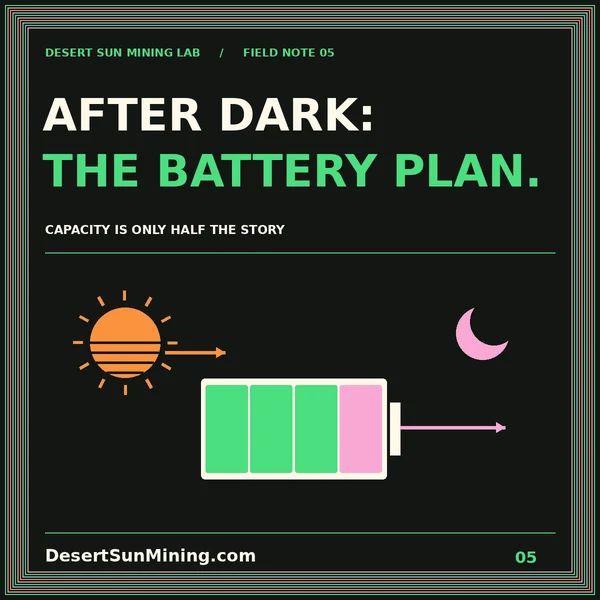
A storage-backed installation shifts some generated energy into later hours. The battery adds its own power limits, usable-energy limits, losses, installation requirements, and replacement considerations. It can bridge a chosen interruption, but it cannot create missing energy. Decide which interruption you are solving: a brief cloud, an evening session, or a longer outage.
Measure the entire load
Start with power at the electrical supply point, using suitable metering installed or selected by a qualified person. Include the mining machine, its power supply, ventilation, network equipment, and any other equipment dedicated to the installation. A specification for the main device is a starting reference, not a substitute for the whole-site measurement.
Consider an illustrative combined load of 3.2 kilowatts. Running for six hours consumes 19.2 kilowatt-hours; running for twenty-four hours consumes 76.8 kilowatt-hours. The multiplication is straightforward, but the difference changes the project completely. These are assumed figures for explaining energy arithmetic, not the specification of a recommended miner or a prediction for your site.
Record startup behavior and the operating mode used during each measurement. A quiet mode, an efficiency setting, or a different cooling arrangement may change consumption and output. Record those changes together. Comparing yesterday’s energy with today’s accepted work is not meaningful when the configuration changed and no one wrote it down.
Treat mining and the electrical installation as different systems
The computing checklist includes compatible mining hardware, supported firmware, network access, monitoring, and a payout arrangement that you understand. The electrical checklist includes the supply architecture, protection, isolation, grounding, inverter compatibility, and installation constraints. Passing one checklist does not imply that the other is complete.
Do not improvise direct connections between panels and a mining power supply. The solar source varies, while the equipment expects specified input conditions. Have a competent designer define the interface and protective equipment. Keep installation documents and shutdown instructions where the responsible operator can find them without relying on an internet connection.
Plan the physical location as well. A place that looks convenient on a diagram may be unsuitable once noise, exhaust airflow, dust, service access, or proximity to people is considered. Before expanding, operate the pilot in its intended enclosure and observe the actual working environment rather than relying only on a desktop estimate.
Read pool and wallet terms before committing work
A mining pool can combine work from participants, but the payout method, fees, thresholds, and accounting rules matter. Read the provider’s own terms and understand how the dashboard reports accepted and rejected work. An attractive headline rate is not enough to explain how a specific account will be paid.
Keep payout credentials and recovery information private. Never put wallet recovery words into a monitoring dashboard, website contact message, or support conversation. Verify destination information using your own trusted records. A solar installation can be technically sound while its account practices remain careless; the two forms of risk need separate attention.
For the pilot, compare the miner’s local statistics with the pool’s records over a defined period. Investigate differences before expanding. Write down downtime, rejected work, configuration changes, and network interruptions. This creates an operating history that is more useful than a screenshot taken during a particularly good hour.
Build a cost ledger without inventing a payback date
Separate equipment purchases from operating costs. The initial list may include the miner, solar equipment, electrical work, enclosure, network equipment, and metering. The recurring list may include imported electricity, connectivity, maintenance, cleaning, repairs, and pool charges. Battery replacement and equipment downtime belong in the planning discussion even when their timing is uncertain.
Make alternative uses of the electricity visible. The same daytime energy might support another site load or remain unused, depending on the installation. Avoid counting the full solar equipment cost against several projects independently, or treating the energy as costless solely because the fuel is sunlight. A transparent allocation is more useful than an impressive but unexplained return figure.
Use at least a restrained case and an interruption case alongside your preferred assumptions. What happens when production is lower, equipment is unavailable, or mining receipts disappoint? This is a way to expose dependence on assumptions, not to forecast the market. Stop the project if it requires an outcome you cannot afford to miss.
Run a small commissioning sequence
Begin by confirming documentation, electrical sign-off where applicable, monitoring visibility, and the responsible person for shutdown. Then test a normal start and stop under the conditions allowed by the equipment manufacturer. Record what the system does when its intended energy limit is reached. Do not bypass protective behavior merely to extend operating time.
After a limited operating period, review whether the original learning objective was met. Did the installation stop as intended? Could you reconcile energy use with machine activity? Were maintenance access and noise acceptable? Resolve those questions before increasing the load or adding storage. The array-sizing walkthrough is the next step once your load and schedule are documented.
Conclusion: design around an honest operating envelope
A useful solar mining project has boundaries: a defined load, a defined schedule, a shutdown rule, and a budget that can tolerate disappointing results. Sunshine is an input to that system, not a substitute for the system. Start small, measure the whole installation, and let observed operation—not a promotional earnings figure—determine whether the next stage deserves further work.