Prepare the whole workflow
Arrange ingredients, utensils, thermometer, storage, and serving equipment before heating begins.
A useful solar cooking plan covers ingredients, equipment, the cooking method, temperature verification, and what happens if conditions change.

Choosing a solar cooker is the start of planning, not the end. Preparation, safe storage, cooking, serving, and leftovers each need an appropriate method. Identify the dish and the responsible operator before beginning. The equipment’s ability to collect heat does not establish the safety of the food placed inside it.
The food-safety field guide links to the USDA reference used for its handling and temperature guidance. For a commercial activity or a location with different requirements, consult the applicable local food authority. Follow a validated method suited to the particular food and equipment.
Arrange clean utensils, raw ingredients, and ready-to-eat food so the operator can keep them separate. Have a suitable thermometer and a clear place to put a hot vessel. Check that the storage and serving equipment are available before preparing a quantity that cannot be handled safely.
For unfamiliar equipment, begin with a simple, controlled task rather than a large menu. Write down what the operator needs to observe and who takes over during a handover. A clear process makes it easier to identify a missing tool or an unresolved safety question before the cooker is in use.
A chamber reading, a warm lid, or a browned surface is not a substitute for appropriate food-temperature checks. Use a suitable thermometer according to its instructions and identify where the measurement was taken. The required cooking process depends on the food, not on how bright the sky looks.
Final-temperature targets also do not validate an arbitrary slow warm-up. Do not assume that eventually reaching a target erases an unsafe cooking history. The detailed guide separates final temperatures from holding and handling limits so those controls are not confused.
Keep a suitable backup heat source ready when the process depends on completing a cooking stage. If conditions no longer support the validated method, respond promptly under that method and the relevant food-safety guidance. Do not leave partly cooked food waiting indefinitely for the sun or plan to finish partially cooked meat much later.
If a safe handling and cooking history cannot be established, discard the food rather than treating reheating as a repair for uncertainty. Record the interruption for future equipment planning, but do not make the meal’s safety depend on achieving a successful demonstration.
Use the solar oven guide to compare the physical setup, cookware fit, and maintenance needs. Follow manufacturer instructions for hot surfaces, concentrated reflections, wind limits, and safe stow positions. Keep uninformed visitors away from the active working area.
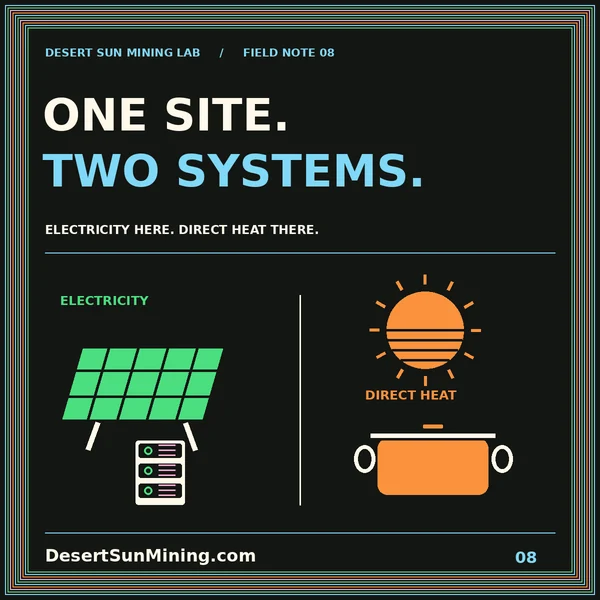
At a combined cooking and computing site, review the shared-energy concept before placing equipment. Food preparation should not become an improvised use of mining exhaust, and a thermal cooking process should not be mistaken for cryptocurrency mining.
Use the original documentation to check context and limitations before applying a claim to a specific installation.
Arrange ingredients, utensils, thermometer, storage, and serving equipment before heating begins.
Use food-appropriate checks rather than judging a meal by its surface or chamber temperature.
Keep suitable backup cooking available and reject food with an unsafe or uncertain handling history.
Two useful distinctions for this part of the solar plan.
Build a complete plan for preparation, verified cooking, changing conditions, hot holding, and leftovers.
Match a cooker to your meals, cookware, site, and available attention—not just its advertised peak temperature.
Explore a shared-energy concept while keeping electrical loads, direct heat, food handling, and site priorities distinct.