A solar oven should be chosen around the meals you intend to prepare, the space available, and the attention you can give it. The most dramatic reflector is not automatically the most useful cooker. A portable setup for an occasional outdoor meal has different requirements from a stationary cooking area used repeatedly by a household or community group.
Begin by describing a typical cooking session: the number of portions, the cookware, the available sunny area, and the backup method. Then compare designs against that description. The Desert Sun Solar Oven guide introduces the main options; this article develops a practical selection process without assuming a particular product is available or suitable in every country.
Understand the three common design families
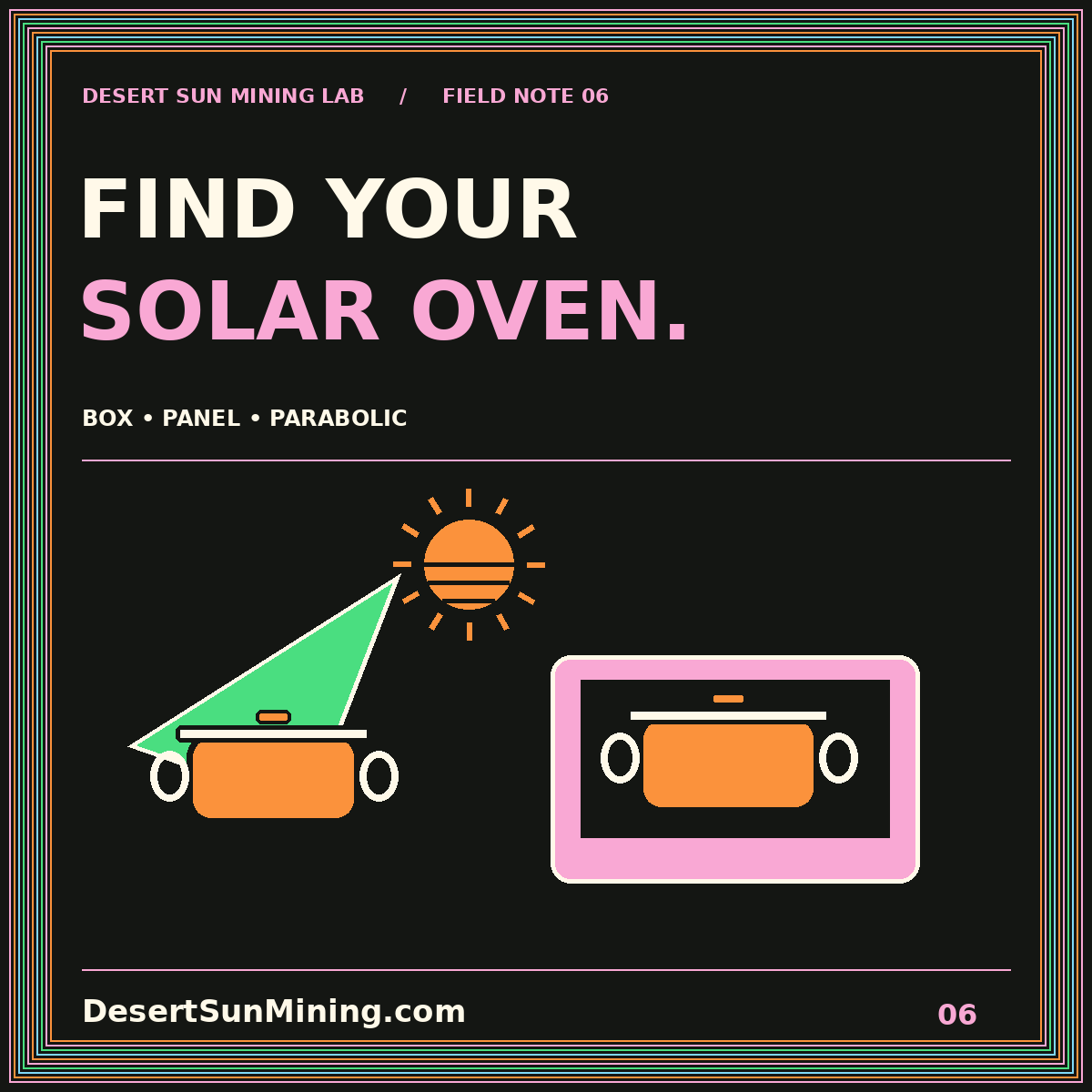
The Solar Cookers International introduction to solar cooking describes reflective-panel, box, and parabolic cookers. Panel designs direct sunlight toward a vessel within a heat-trapping enclosure. Box designs retain heat within an insulated chamber with a transparent opening. Parabolic designs focus reflected sunlight toward a cooking position. Those mechanisms explain why the designs require different handling and setup.
Do not use the family name as a complete specification. Two box cookers can differ in usable space, materials, insulation, and access. Two panel cookers may need different pots or heat traps. Ask for the actual operating instructions and test information for the model being considered rather than assuming every example of the same type performs alike.
Treat specialist designs separately
Some cookers use evacuated tubes or other arrangements that do not fit neatly into the three basic families. Evaluate them through their own loading, cleaning, handling, and replacement requirements. A novel shape is neither proof of superior performance nor a reason to dismiss a design without examining the intended use.
Begin with cookware and portions
Measure the cookware you already use or intend to purchase. Include handles, lids, and the clearance needed to place and remove the vessel safely. A chamber’s outside dimensions do not establish its usable internal space. Ask whether the proposed pot and food load are consistent with the manufacturer’s instructions.
Write down the ordinary meal rather than the largest imaginable occasion. A cooker selected only for a rare large gathering may be awkward for daily use. Conversely, a compact product that handles a demonstration portion may not serve the intended household. Ask for performance information at a load that resembles your real use, not just an empty-chamber temperature.
Consider handling when the vessel is hot. Where will it be placed after removal? Can the lid be opened without leaning over steam? Is there a stable work surface nearby? These questions are especially important when a cooking area must be shared with children, visitors, or people unfamiliar with the equipment.
Match the design to the available attention
Describe who will monitor the cooker and how often they can check it. A design that needs frequent repositioning may be inconvenient for someone who cannot remain nearby. A design that appears simple still needs the supervision and adjustment specified in its instructions. Solar operation is not permission to leave hot equipment unattended around other people.
For a proposed installation, rehearse the operator’s movements without food or concentrated sunlight. Identify where the person stands, how the vessel is accessed, and where reflectors move. A dry planning exercise can reveal a cramped layout before the equipment is in active use. Follow the manufacturer’s setup procedure for the actual cooker.
Keep backup cooking realistic. If clouds interrupt the session, the alternative heat source must be available and appropriate for the food, not merely listed in a plan. The solar cooking safety guide explains why a finished appearance or a warm chamber is not enough to establish food safety.
Evaluate the site rather than a photograph
Identify a stable area with suitable sunlight and sufficient space for the full operating footprint. Include reflector movement, operator access, and a safe boundary for other people. A product photograph may show the cooker alone, while the real installation also needs a table, utensils, shaded preparation space, and a clear route for carrying hot food.
Watch how shadows move across the intended area during the actual cooking period. A location that is open at noon may be shaded when the meal begins or ends. Record the observation instead of relying on a single photograph. A practical cooking window is specific to the site, season, and surrounding obstacles.
Discuss wind exposure and securing methods with the supplier. Do not improvise attachments that change the reflector geometry, block ventilation, or create a tipping hazard. The operating instructions should explain allowed conditions and what to do when those conditions are exceeded. A safe storage position matters as much as an operating position.
Compare useful performance evidence
Ask what the available test actually measured. Was it cooking power, heating time for a specified load, a temperature reached without food, or a user report? These answer different questions. A maximum temperature alone cannot describe how quickly the cooker will prepare your meal or how it behaves when conditions change.
Request the test conditions and the product configuration. Reflector position, vessel type, load, wind, and solar conditions may affect interpretation. You do not need to reproduce a laboratory test to ask whether two claims are being compared on the same basis. Refuse to turn incomparable numbers into a confident ranking.
Keep your own acceptance criteria narrow. For example, you might require that the cooker accommodate a particular vessel, be manageable by the intended operator, and have clear instructions and replaceable service parts. These criteria are verifiable before purchase and may be more useful than an unsupported claim about the “fastest” solar oven.
Inspect maintenance and replacement requirements
Ask how reflective surfaces, transparent covers, seals, and food-contact components should be cleaned. Identify parts that can be replaced and the process for obtaining them. A cooking surface that cannot be cleaned as instructed is a practical problem even if the initial demonstration looks successful.
Check storage requirements as well. A portable cooker still needs a place where its surfaces will not be damaged and where concentrated reflections cannot create a hazard. Ask how the product should be folded, covered, transported, and secured when not operating. Include the cost and space of any required case or protective cover.
Do not assume that a product described as simple is maintenance-free. Record the supplier’s instructions and review them with the people who will use the cooker. Shared equipment especially benefits from a consistent handover: what was cleaned, what was damaged, and whether the next user needs to inspect anything before setup.
Compare the complete ownership package
A useful comparison includes the cooker, compatible cookware, thermometer, handling equipment, transport or mounting arrangement, and any required replacement consumables. Keep those items visible rather than comparing only the advertised cooker price. Confirm shipping, support, and availability directly with the supplier when making an actual purchase.
Consider a supervised demonstration or a small trial when feasible. Use the intended food load and operating setting rather than asking only whether the equipment becomes hot. A trial should assess handling, cleaning, access, and whether the operator can follow the instructions comfortably. It is not a substitute for validated food-safety practice.
Write down the reason for your selection in plain language. “Fits our pot, has documented operation, and can be managed in our cooking area” is more useful than “looks powerful.” That record helps the next operator understand the equipment’s intended role and prevents later use outside the assumptions that supported the purchase.
Conclusion: select for the meal and the operator
Choose a solar oven through its actual cooking task, documented performance, safe operating space, and maintenance requirements. Design families help organize the options, but they do not replace a model-specific evaluation. The most useful cooker is one whose limitations are understood and whose operation fits the people, cookware, and conditions at the site.