Define useful output
Choose a representative task with known inputs and verifiable results.
Use “solar AI GPU mining” as a starting question—not a claim that AI inference, GPU workloads, and Bitcoin mining are the same activity.
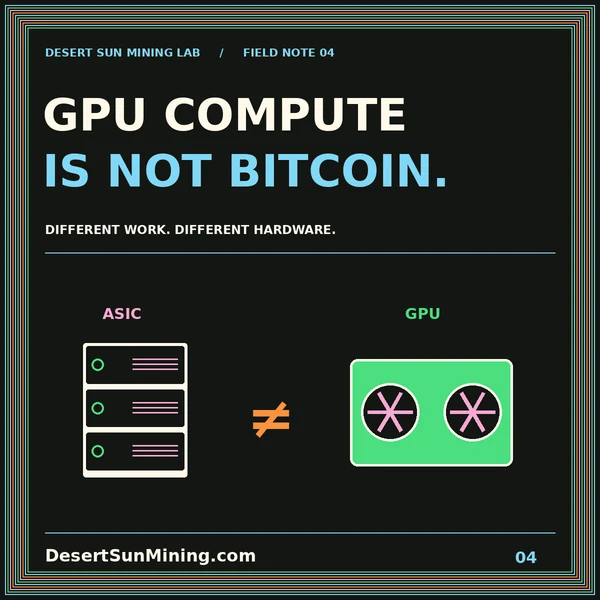
AI inference, training experiments, media processing, and cryptocurrency work have different requirements and measures of completion. A graphics processor running a model is not performing Bitcoin mining merely because it consumes solar-generated electricity. Start with a concrete task and an output that can be checked.
For a local batch job, that may mean processing every input and validating every result. For an interactive service, it may mean a documented response and availability requirement. For cryptocurrency work, identify the network and supported algorithm. A utilization percentage alone cannot show that any of these goals has been met.
Prepare a repeatable test with known inputs, a documented software environment, and clear success criteria. Confirm memory, storage, and compatibility needs on the intended hardware. Avoid choosing a GPU solely from a benchmark for work the site will not perform.
The GPU-versus-Bitcoin field note explains how to compare useful output with total energy. If you change a supported power setting, repeat the same job and validate its result. A lower instantaneous reading is not automatically lower energy per completed task.
GPU telemetry is useful context, but include the host CPU, memory, storage, networking, and cooling in the system boundary. Record what remains powered between jobs. A graphics processor that pauses overnight may still leave an unplanned supporting load running.
Use the exact hardware’s documentation to interpret power and temperature fields. Monitoring capabilities and supported controls can vary. Do not assume a tool example applies to every model or override protective limits to fit an optimistic schedule.
Distinguish jobs that can wait, jobs that can pause, and services that must remain available. Test checkpoint creation and recovery before relying on either. A claimed pause feature is not enough until the actual workload can resume and produce a valid result.
Build a normal stopping rule and a separate fault response. Then take the measured load schedule to the solar systems guide. An hourly production model can inform scheduling, but the actual controls must also handle changes inside an hourly interval.
A working GPU does not establish demand for paid computing. Before offering a hosted service, define access controls, data handling, workload isolation, support, and the promised completion or response conditions. Do not advertise security or availability guarantees that have not been implemented and tested.
For a first pilot, a known local job may be easier to evaluate than arbitrary external workloads. Record actual completed work and actual receipts separately. Keep technical capability, service operation, and revenue assumptions from becoming one unsupported claim.
Use the original documentation to check context and limitations before applying a claim to a specific installation.
Choose a representative task with known inputs and verifiable results.
Pair wall-energy measurements with completed work, configuration, and elapsed time.
Verify checkpointing or a safe stop before depending on a flexible solar operating window.
Two useful distinctions for this part of the solar plan.
Different workloads need different hardware. Define useful output, measure wall power, and test recovery before scaling.
A transparent sizing example that separates daily energy, hourly output, and the capacity your equipment actually needs.
Explore a shared-energy concept while keeping electrical loads, direct heat, food handling, and site priorities distinct.